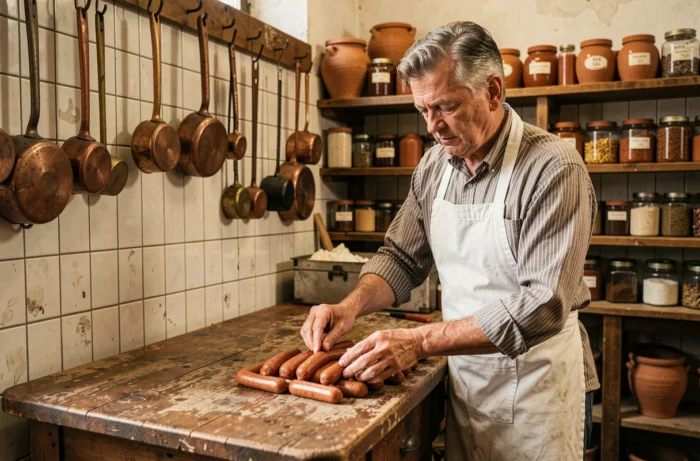
The Frankfurt sausage is named after a city, but the name refers to different products depending on the country. In Germany, Frankfurter Würstchen means a sausage made entirely from pork, smoked and stuffed into a sheep casing.
In Austria, the term Frankfurter refers to a sausage made with both pork and beef, similar to what Germans call Wiener Würstchen. This rarely explained confusion over terminology shows that questions of origin are also a matter of language and commercial borders.
Frankfurter and Wiener: a comparison of two sausages that differ in everything but their names
The connection between these two products is often attributed in historical sources to Johann Georg Lahner, a butcher from Frankfurt who settled in Vienna in the 19th century. The recipe he is said to have adapted in Vienna includes beef as well as pork, which is the fundamental difference between the two traditions.
| Criterion | Frankfurter Würstchen (Germany) | Wiener Würstchen / Frankfurter (Austria) |
|---|---|---|
| Meat | Pork only | Mix of pork and beef |
| Casing | Natural sheep casing | Natural sheep casing |
| Smoking | Beechwood | Beechwood |
| Casing color | Yellow-ochre | Pink to ochre, depending on the manufacturer |
| Name in the neighboring country | Called Frankfurter in Austria | Called Wiener in Germany |
This table highlights a paradox: the smoking process and casing are identical; only the meat differs. The shared production process (fine mincing, precooking, and beechwood smoking) confirms a direct technical link between Frankfurt and Vienna.
To learn more about the origins of Frankfurt sausages, it is important to recognize that this connection remains a local historical claim rather than an indisputably documented fact.
Artisanal and industrial Frankfurt sausages: what the labels mean
The ingredients in a Frankfurter sold at a supermarket differ radically from those in one made by a butcher. French regulations allow consumers to distinguish between three quality levels, with specific differences between them.
- The label “traditional” or “old-fashioned” guarantees natural sheep casings and no additives other than nitrate, sodium nitrite, and ascorbic acid.
- The label “superior quality” allows artificial smoking using smoke flavoring, as well as the addition of stabilizers and flavor enhancers.
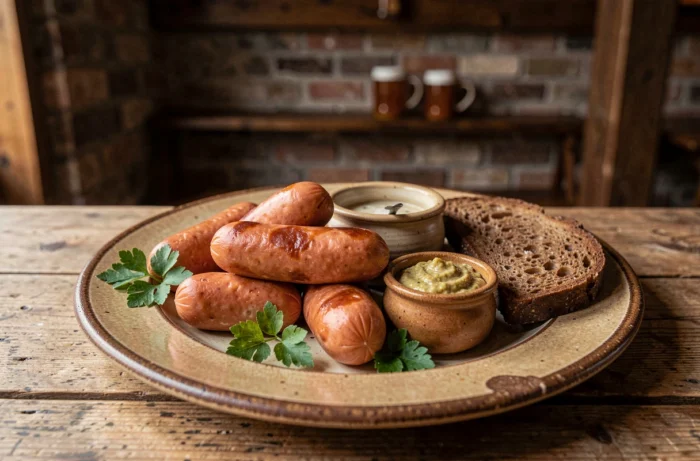
- At a butcher’s shop, the color tends toward pinkish orange, whereas the industrial version has a yellow-ochre color caused by additives and the smoking process.
This hierarchy may come as a surprise: “superior quality” does not mean the best product, but a level below “traditional.” Here, French regulatory terminology runs counter to the intuitive meaning of the words.
Precooking and final cooking: a strict protocol
Frankfurt sausages are already precooked. They should be heated in simmering water, never boiling, for five to ten minutes. This temperature requirement is no minor detail: water that is too hot will split the natural sheep casing and affect the texture of the finely minced meat.
As well as being poached, the sausage can be pan-fried, baked, or grilled. Poaching remains the standard method in Germany, where Frankfurters are most often served with mustard and bread.
Frankfurter Würstchen and the American hot dog: two different paths
Frankfurt sausages arrived in the United States with the waves of German migration in the 19th century. The product underwent a radical transformation there: beef often replaced pork, synthetic casings took the place of natural ones, and the long bun became central to the way it was served.
The result is a product that shares with the original Frankfurter only its cylindrical shape and the fact that it is precooked. Its ingredients, flavor, smoking process, and serving style differ in almost every respect.
Why the name Frankfurter persists in the United States
The term Frankfurter is still used in American English to describe a category of precooked sausages, even when the recipe has little to do with Frankfurt. This persistence illustrates a common phenomenon in food: the original name often survives long after the product itself has changed.
Frankfurt sausages in Germany: consumption is declining
Available data point to a decline in sausage consumption in Germany in recent years. This downturn affects the entire charcuterie sector, and Frankfurters are no exception.
Several factors help explain this trend:
- The rise of plant-based diets and the deliberate reduction of meat in everyday meals.
- Concerns about additives (nitrites and nitrates) in processed products.
- Competition from imported sausages and plant-based alternatives gaining visibility in German markets.
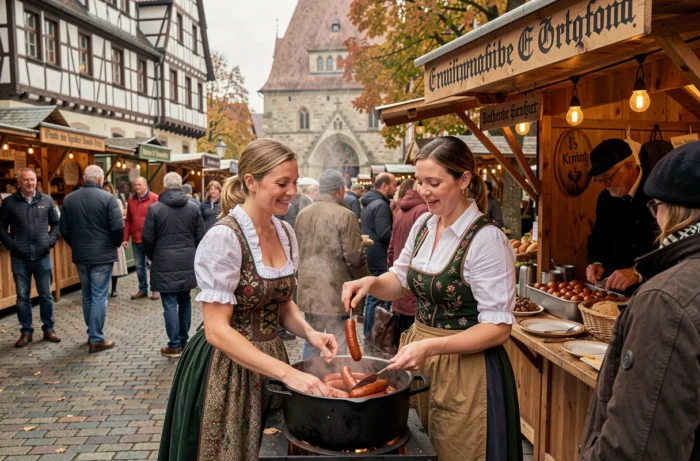
Frankfurters retain strong symbolic significance, particularly at fairs and markets (the Weihnachtsmärkte are a prominent example). Their role in German food culture goes beyond everyday consumption: they remain a marker of regional identity for Frankfurt am Main.
The question of geographical protection for the name Frankfurter Würstchen is also the subject of regulatory debate in Europe. Protected geographical indications govern the use of certain sausage names, but how these protections are applied in practice varies across markets and sales platforms. The distinction between a Frankfurter made in Frankfurt and a sausage bearing the same name elsewhere remains a commercial as well as a historical issue.