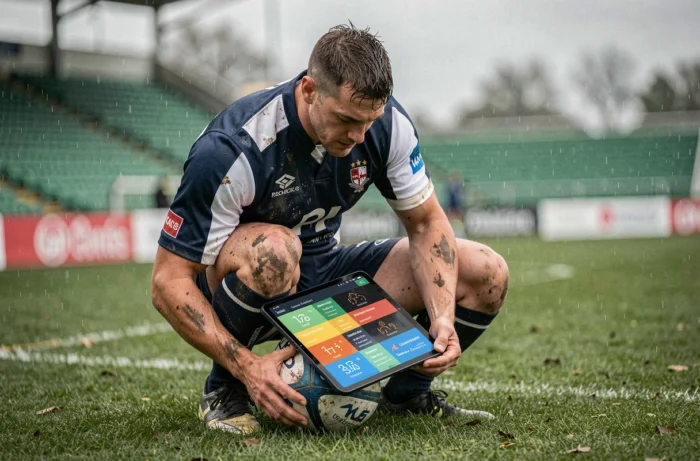
Allrugby centralizes rugby statistics across a broad range of French competitions: Top 14, Pro D2, Nationale and the French national teams. It offers player profiles, transfer histories, live standings, and JIFF tracking by club and matchday squad. The platform also covers the transfer market in a level of detail rarely found on general sports news sites.
Offensive and defensive bonus points: rules that vary by competition
The points system shown on Allrugby for the Top 14 follows a stable scale: four points for a win, two for a draw, an offensive bonus for scoring three or more tries than the opposition, and a defensive bonus for losing by five points or fewer. These thresholds are familiar to anyone who follows the French league.
The 2026-2027 season introduces a difference to bear in mind when checking European competitions. In the Champions Cup and Challenge Cup, the offensive bonus calculation has changed, while the defensive bonus applies to losses by seven points or fewer. This two-point difference between the Top 14 and European cups can skew a quick reading of the standings if you switch between tabs without adjusting your frame of reference.
Allrugby displays each competition’s rules in dedicated boxes, making it easy to check the applicable scoring system before comparing a club’s performances across multiple competitions. For more information on how the platform works, Goall’s Allrugby statistics site guide explains the main sections and how to use them.

JIFF and the salary cap: data that sheds light on club strategy
JIFF (Players Developed Through Training Pathways) data is among the most widely used features on Allrugby by regular Top 14 and Pro D2 followers. The platform ranks clubs by JIFF percentage in matchday squads, making it easy to see whether they are meeting the quotas set by the LNR.
This data is far from trivial. It directly affects recruitment policy. A club close to the minimum threshold approaches transfers differently from one with a surplus. Allrugby’s transfer tables, broken down by division (Top 14, Pro D2, Nationale), become especially useful when viewed alongside JIFF percentages.
On the financial front, changes involving a player exemption from the salary cap have been reported for the current season. Measures of this kind affect clubs’ room to recruit and retain players. Allrugby does not publish salary data directly, but tracking contract expirations and transfers makes it possible to piece together the moves linked to these regulatory adjustments.
What the transfer tables reveal
The transfers section is more than a calendar of arrivals and departures. It also lists players whose contracts are expiring, giving observers an early overview of potential moves. For a sporting director or agent, it is a monitoring tool. For a well-informed supporter, it offers a way to understand why a club is recruiting for one position rather than another.
Allrugby and amateur rugby: coverage focused on Nationale
Volunteers and officials at amateur clubs often ask whether Allrugby covers the lower divisions in the same level of detail. The answer is nuanced. Nationale receives comprehensive coverage (standings, club profiles and player statistics), similar to that available for the Top 14 and Pro D2.
Coverage thins out below Nationale. Regional competitions and Fédérale pools do not receive the same statistical treatment on the platform. Officials at Fédérale 1 or 2 clubs looking for consolidated results often have to consult several sources.
Amateur league pyramid reform: what changes from 2027-2028
The 2026-2027 season is described as a transition period for determining the structure of the new amateur league pyramid, ahead of a reform announced for 2027-2028. Clubs currently in Nationale (Albi, Bourgoin, Chambéry, Massy, Marcq-en-Baroeul, among others) are keeping a close eye on these developments, as they could reshape the pools and promotion requirements.
Allrugby lets users follow these clubs’ standings and results during this pivotal period. However, the platform remains silent on the administrative and regulatory aspects of the reform: the implementation schedule, selection criteria and impact on the budgets of the clubs concerned.

Oval-e, Mon Rugby and the FFR’s digital tools: what Allrugby does not cover
The FFR is currently rolling out a digital tool called Mon Rugby to replace Oval-e. A training tour for regional stakeholders is accompanying its launch, with implementation targeted by June 2027. The tool is designed to simplify clubs’ day-to-day administrative tasks: registrations, team sheets and tracking regional competitions.
This is precisely the kind of service Allrugby does not offer. The platform focuses on viewing sports data (results, statistics, standings and transfers), not on the day-to-day management of clubs. For an amateur club volunteer, the two tools serve different needs:
- Allrugby for checking Nationale standings, player profiles and transfers between professional and semi-professional divisions
- Mon Rugby (Oval-e’s successor) for managing registrations, entering team sheets and handling the administrative tracking required by the FFR
- Regional league websites for Fédérale competition results and territorial pools, which are often missing from Allrugby
Allrugby’s value to the amateur game is therefore focused on results and statistics, not regulatory guidance. Club officials seeking to understand the practical impact of the 2027-2028 reform on their competitions will need to consult communications from the FFR and regional leagues.
Player profiles and history: the depth of data that makes the difference
Every player listed on Allrugby has an individual profile tracing their career: successive clubs, number of matches and positions played. This level of detail goes beyond what most rugby news sites offer, as they generally limit themselves to the squads for the current season.
For the competitions it covers, individual statistics list the top points scorers, goal-kickers, try-scorers and most penalized players. These rankings are available by competition (Top 14, Pro D2, Nationale) and updated throughout the season.
The lack of European competition data at the same level of detail remains a limitation. Champions Cup and Challenge Cup standings do not offer the same wealth of statistics as domestic leagues, forcing users to switch between several platforms to fully track a player competing in both.