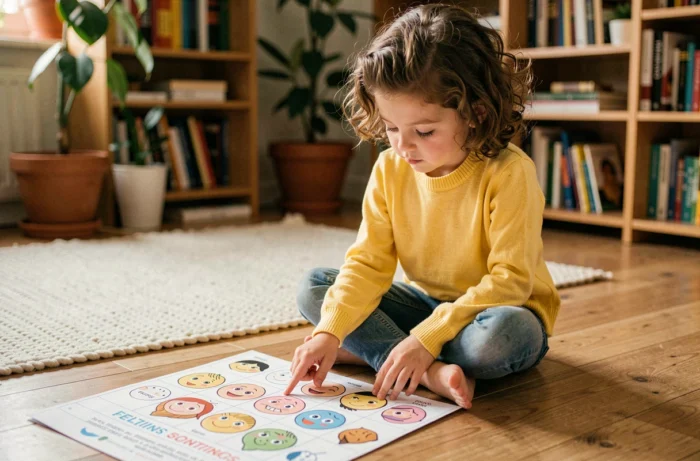
A four-year-old has a tantrum at the supermarket. His mother tries to calm him down, his father raises his voice, and the next day at school, his teacher tells him to sit in the calm corner. Three adults, three different reactions, and no consistent guidance for the child. Learning to recognize and regulate emotions in everyday life depends on more than a single tool or technique: consistency among the adults around the child matters just as much as the approach used at home.
Conflicting messages from adults and children’s emotional regulation
When a child expresses anger, they often get opposing responses depending on where they are and who they’re with. At home, they’re encouraged to take a breath. At school, they’re told to be quiet. At their grandparents’ house, their feelings are brushed aside. The child no longer knows what response is expected, let alone what they’re really feeling.
France’s psychosocial skills framework distinguishes emotional skills (identifying emotions, regulating them, managing stress) from cognitive and social skills. Reducing emotional learning to “calming down when angry” misses the point: understanding what is happening in their body and knowing how to talk about it are integral parts of the process.
The most structured approaches in France involve several adults and settings. The idea is to create continuity between home, school and leisure activities, rather than letting each setting come up with its own rules. To help young children regulate their emotions, coordination among adults is an often-overlooked tool.
In practice, this starts with using shared language. If a teacher uses an “anger thermometer” in class, parents can use the same tool at home. The child has a consistent point of reference, whoever they’re with.
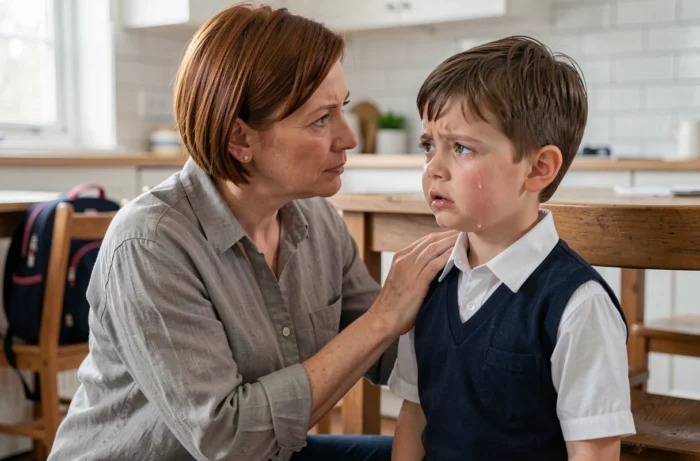
Putting emotions into precise words: building emotional vocabulary every day
A child who says “I’m angry” when they’re actually frustrated, disappointed or tired is using one word for very different feelings. Expanding a child’s emotional vocabulary can improve their ability to regulate their emotions. A child who can tell frustration from disappointment can begin to identify what they need.
You don’t need a structured program to do this. A few everyday habits are enough:
- Describe what you observe without interpreting it: “You’re clenching your fists and making a face. It looks like something is bothering you” rather than “Stop making a fuss”
- Offer two or three words to choose from: “Do you think you’re more disappointed or more angry?” so the child can work it out for themselves
- Name your own emotions out loud: “I’m feeling frustrated because I’m running late” shows that adults have emotions too, and that’s nothing to worry about
This practice works best outside moments of crisis. During an emotional outburst, a child’s prefrontal cortex is in alert mode. First, acknowledge their feelings; then, once they’ve calmed down, help them put those feelings into words.
How it varies by age
Before the age of five, children aren’t neurologically mature enough to regulate a strong emotion on their own. The goal isn’t to teach them to “manage” it, but to support them physically through your presence, touch and a calm tone of voice. Emotional independence develops gradually; it can’t be switched on at will.
Between the ages of six and eight, children can start using simple strategies to calm down, provided they’ve practised them beforehand in a relaxed setting. After the age of eight, putting feelings into words becomes a self-regulation tool in its own right.
Practical tools for managing emotions in everyday family life
There’s no shortage of tools, but their effectiveness depends on two things: using them regularly and having adults use them too. A glitter jar left on a shelf and never taken down is no use at all.
A “calm-down corner” works when it isn’t used as a punishment. If a child is sent there against their will, they’ll associate emotional regulation with being punished. The space should be offered as a choice, with items the child has chosen themselves, such as a cushion, a book or a stress ball.
Guided breathing is one of the easiest techniques to try. Visual aids can make it more engaging: blowing on a pinwheel or watching a stuffed toy rise and fall on their belly. The key is to practise at a regular time of day, such as before bed or after school, so it becomes second nature.
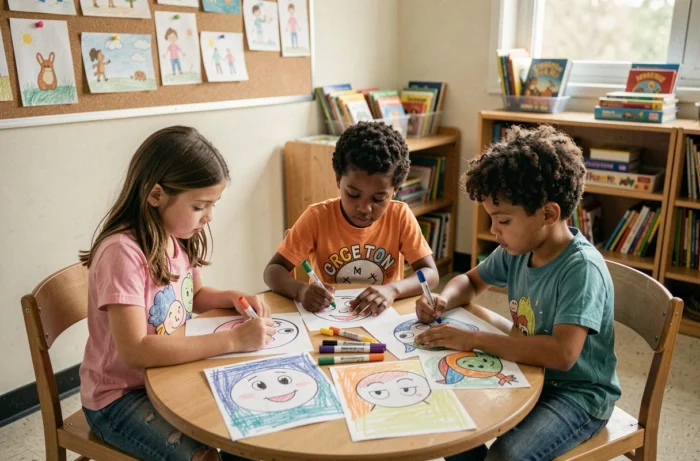
Activities that build emotional awareness
Some activities naturally support emotional development without making it feel like a school exercise:
- Free drawing after a day at school, followed by an open-ended question (“Tell me about your drawing”), gives children a way to express what stood out to them without feeling interrogated
- Role-playing with figurines or puppets gives children some distance to act out a difficult situation again and explore other possible responses
- Reading stories about characters experiencing a range of emotions opens up conversations about situations children may not feel comfortable bringing up directly
These activities work because they’re based on play, not instructions. Children can explore their feelings at their own pace.
When managing emotions goes beyond the family
Emotional regulation isn’t just about a child’s individual well-being. Structured programs that develop psychosocial skills report benefits for peer relationships, conflict resolution and reducing risky behaviours over the longer term. Learning to manage emotions also prepares children for social life.
France’s strategy emphasizes training for adults who work with children and evaluating the quality of interventions. A one-off classroom workshop on emotions has little lasting impact if it isn’t reinforced at home and during extracurricular activities.
Consistency is the most common sticking point. When one parent validates a child’s emotional expression but their sports coach shuts it down, the child learns to compartmentalize rather than regulate their feelings. Talking with other trusted adults—teachers, activity leaders and grandparents—about a few simple principles, such as not dismissing emotions or expecting a child to calm down immediately, is often enough to create a more consistent environment.