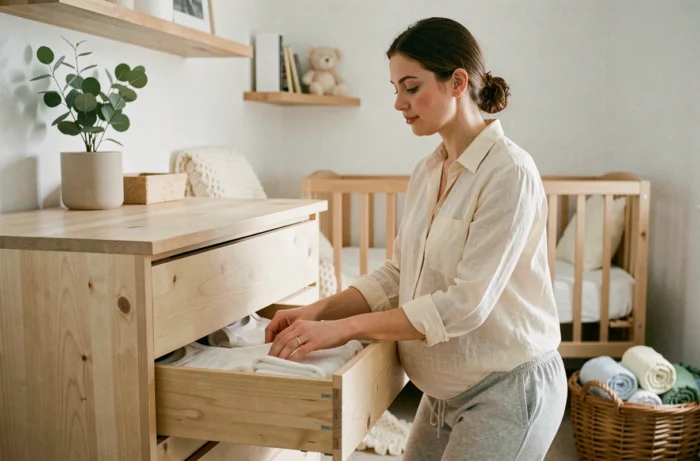
When preparing the baby’s room, the priority is on sleeping safety, air quality, and practical organization for the first months. Here are ten concrete tips for setting up this room without any unpleasant surprises.
1. Air out the room several weeks before installing the furniture
We often think about ventilating after assembling the furniture. The problem is that volatile organic compounds (VOCs) emitted by paints, glues, and particle boards concentrate as soon as the boxes are opened. Limiting infants’ exposure to these indoor pollutants remains a basic precaution.
The right method: paint and lay the flooring at least four to six weeks before the expected delivery date, then air out the room with the windows wide open at least twice a day. You can find everything on the Maman m’adore website to anticipate each step of the preparation schedule.
2. Choose paints and materials labeled A+ for VOCs
Since 2013, French regulatory labeling has imposed a classification of VOC emissions on construction and decoration products. Class A+ corresponds to the lowest emission level.
We aim for this class for wall paint, flooring, and varnishes. So-called “natural” or “eco-friendly” paints do not automatically guarantee a good rating. Check the A+ label on each can remains the most reliable action before any purchase.
3. Plan for sleeping arrangements in the parents’ room for the first months
French recommendations for preventing sudden infant death syndrome, relayed by Santé publique France, suggest that the baby sleeps in the parents’ room, in their own bed, for the first weeks. Preparing the permanent room does not exempt you from setting up a compliant crib next to the parental bed.
Specifically, plan for a clear space in the parents’ room with a compliant crib or co-sleeping bed, soft night lighting, and a small storage area for diapers and night bodys. The baby’s room will mainly be used for naps and daytime changes at the beginning.
4. Opt for a firm mattress that fits perfectly in the bed
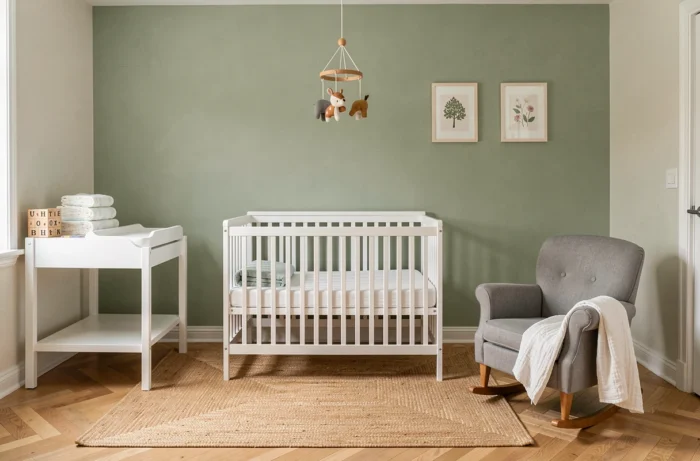
A mattress that is too soft or too small for the bed frame poses a suffocation risk. The mattress must be firm, new, and without gaps between its edges and the bed frame. Check that it does not sink under the weight of a flat hand placed on it.
Used mattresses may have lost their firmness or accumulated moisture. Prioritize a new mattress labeled NF or CE, avoiding memory foam models intended for adults.
5. Secure tall furniture to the wall with anti-tip brackets
An unsecured changing dresser can tip over if an older child grabs it or if an open drawer shifts the center of gravity. The risk is not immediate with a newborn, but we prepare the room for several years of use.
Anti-tip brackets (straps or metal brackets) can be screwed into the wall and the furniture in a few minutes. Always secure:
- The dresser or changing table, especially if it exceeds 80 cm in height
- The wardrobe or closet if it is narrow and tall
- Wall shelves, even decorative ones, with fixings suitable for the type of wall (drywall, brick, concrete)
6. Install electrical outlets with safety covers from the start
Safety covers are inexpensive and can be installed in seconds. Place them before even furnishing the room, including on outlets that seem inaccessible behind furniture. A baby crawls earlier than expected, and moving furniture later exposes a forgotten outlet.
Run cables (nightlight, baby monitor, lamp) behind the furniture rather than along the baseboards to reduce another common accident risk.
7. Ban decorative items in the crib and around the sleeping area
Bumper pads, cushions, stuffed animals, thick blankets: these items increase the risk of suffocation in infants. The recommendations from Santé publique France are clear on this point. The crib should contain a mattress, a fitted sheet, and a sleep sack suitable for the season. Nothing else.
Avoid hanging a mobile directly above the baby’s face with elements that could detach. The mobile should be placed at a distance, out of reach, and used for visual stimulation during supervised awake times.
8. Prefer adjustable lighting with a warm nightlight
A powerful ceiling light is not suitable for nighttime awakenings. Install a warm, low-intensity nightlight that allows you to change and feed the baby without stimulating their wake cycle. The blue light from white LEDs disrupts melatonin production.
A dimmer on the main lamp or an adjustable bedside lamp complements the setup. Avoid string lights within reach of the crib, which combine electrical risk and unnecessary visual stimulation at night.
9. Organize a complete changing station within arm’s reach
Leaving the changing table to fetch a clean bodysuit leaves the baby unsupervised at a height, even for two seconds. Prepare the changing station with everything necessary within arm’s reach:
- Diapers, cotton, and liniment or cleansing water in a basket fixed to the wall or placed on the dresser
- Two or three spare bodysuits and a clean sleep sack
- A changing mat with raised edges and a washable cover
Test the setup before the birth by simulating a complete change. If you have to turn around or bend down, the arrangement is not suitable.
10. Do not scent the baby’s room (no candles, diffusers, or incense)
Essential oil diffusers, scented candles, and incense degrade indoor air quality. Anses warns about infants’ exposure to these sources of pollutants, which release VOCs and fine particles. Healthy air means regular ventilation without added fragrance.
Avoid indoor air fresheners and fabric sprays on bedding. The only recommended cleaning product for surfaces in the room is a mild, unscented cleaner, rinsed and dried before placing the baby in the room.
Completing painting and furniture assembly before the eighth month of pregnancy allows time for proper ventilation of the room. The rest, storage, decoration, and small adjustments, can be gradually implemented after the baby’s arrival.