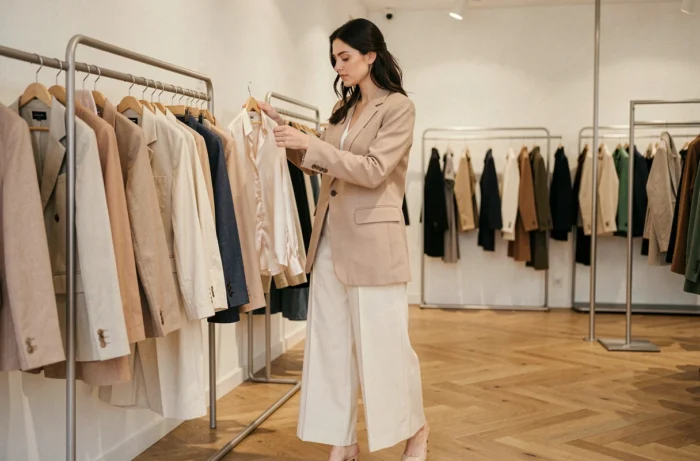
You open your wardrobe one September morning, and nothing matches. The summer pieces feel too light, while last winter’s items no longer align with what you see in the shop windows. This discrepancy is felt every year at the same time, and this season it can be explained by concrete changes in cuts, materials, and colors offered by brands. Here’s what truly deserves your attention to adjust your women’s wardrobe this autumn.
Traceable materials and mono-fibers: what’s changing in labels
Before discussing silhouettes or palettes, let’s look at what we didn’t see on labels two seasons ago. The European Union has established a regulatory framework that requires producers to fund the collection, sorting, and recycling of textiles through extended producer responsibility systems. Member states are expected to transpose this by June 2027, with operational measures planned for April 2028.
Meanwhile, the digital product passport is gradually being implemented for clothing. This involves QR codes or integrated chips that provide exact composition, care instructions, repairability, and end-of-life information for the garment. The infrastructure was activated in 2026.
On the ground, this pushes brands to prioritize mono-fibers and certified materials, which are easier to document and recycle. Thus, there are more pieces made of virgin wool, non-blended organic cotton, or pure linen, whereas previous seasons featured more synthetic blends. If you’re looking for all the news on Magmoiselle, the topic is regularly addressed from a practical angle.

Autumn colors for women: the palette that stands out this season
The spring-summer 2027 fashion shows in London and the first autumn collections in stores outline a clear chromatic direction. We’re moving away from pastel tones and butter yellow of spring towards more muted shades, but not uniformly dark.
Three color families dominate:
- Deep burgundies and chocolate browns, worn in total looks or as statement pieces (coats, wide trousers) on a neutral base.
- Forest greens and khakis, replacing the softer sage greens seen last year, with a preference for matte textures.
- Slate grays, used as an alternative to classic black, particularly on tailored suits and structured shirts.
Black remains omnipresent, but there’s a noticeable return of stark contrast: a saturated color piece paired with black, rather than gradients of neutrals. This marks a shift from the tone-on-tone layering that has dominated for the past two seasons.
Dresses, shirts, and jeans: the feminine pieces changing in cut
The women’s fashion trends this autumn do not reinvent the wardrobe but visibly alter proportions.
The seasonal dress is worn longer, often below the knee, with heavier materials (thick knits, gabardine). Straight or slightly flared cuts take precedence over fitted dresses. We’re looking for controlled volume, not cling.
The shirt returns in a more structured format. Collars are higher, cuffs more pronounced, and fabrics thicker than classic poplin. The oversized shirt in thick cotton works as a light jacket, worn open over a turtleneck or a ribbed tank top.
The barrel jean, spotted in spring, continues its rise. Its rounded cut at the thighs and tapered ankle creates a silhouette different from the classic straight jean. Reactions vary on this point: some body types find the cut flattering, while others deem it less universal than a high-waisted straight jean.
Autumn style: building a look with fewer pieces
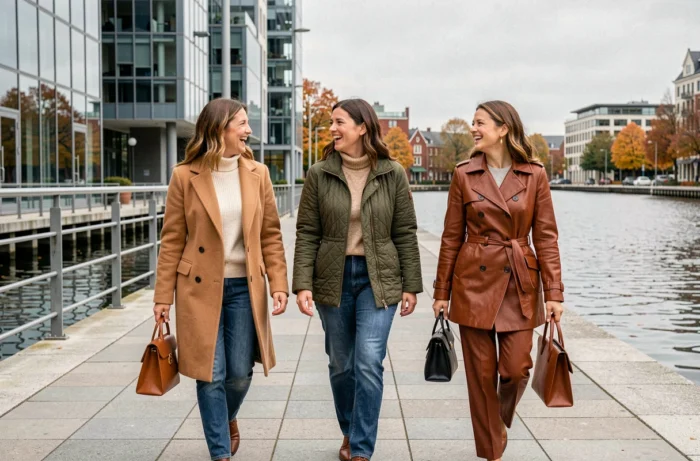
There’s a tangible movement towards outfits composed of a maximum of three pieces. The accumulation of layers (top, shirt, jacket, scarf, coat) gives way to more streamlined combinations where each element is visible and chosen.
In practice, this results in combinations like:
- A wide wool trouser + a high-neck sweater + a straight coat, without unnecessary accessories.
- A mid-length knit dress + flat ankle boots + a structured bag, all in a maximum of two colors.
- A barrel jean + a thick tucked-in shirt + a pair of loafers, with only a leather belt added.
Reducing the number of pieces requires focusing on the quality of each. This is where the trend aligns with regulatory developments: a well-cut mono-fiber garment ages better than a synthetic blend, and it will be easier to recycle when the new obligations come into effect.
Environmental claims and women’s fashion: what will change in stores
A new European regulation will more strictly regulate environmental claims on clothing. Vague mentions like “eco-responsible” or “conscious collection” without documented proof will gradually be banned. The destruction of unsold textiles is also subject to much stricter rules in Europe.
For shoppers, this means that labels will become more precise and technical. We will see information about the country of manufacture, the exact percentage of recycled material, and end-of-life pathways. This is a slow change, but it is already altering the available offerings in stores: brands that cannot document their commitments are removing their green labels.
This season marks a turning point where women’s trends are no longer just about colors and cuts. Materials, their origin, and traceability are becoming as concrete criteria for choice as style or price. The next trip to the fitting room might well start with reading the label.