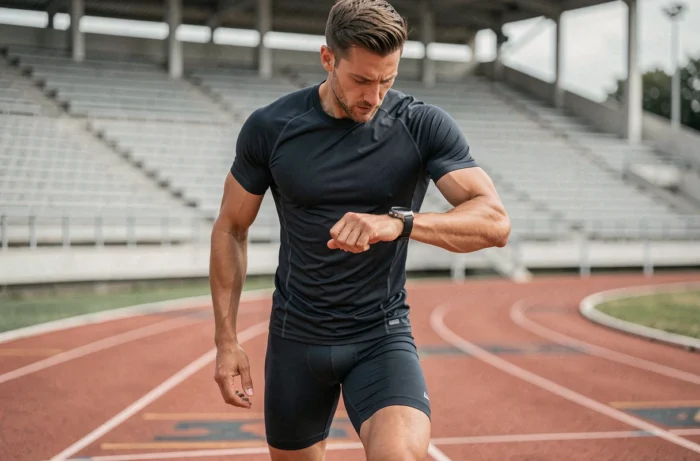
You time your weightlifting sets with your phone’s timer, but a notification interrupts the countdown mid-effort. Or you record a sprint time, only for your thumb to press a half-second too late. A sports stopwatch seems like a simple object, and that’s exactly what leads to neglecting its choice. The difference between a suitable model and a poorly calibrated gadget lies in concrete details: readability, tactile feedback, interval management.
Advertised accuracy vs. actual accuracy: what the manufacturer doesn’t measure
The technical specifications of a stopwatch often display an accuracy to the hundredth of a second. This data pertains to the internal quartz, not the final measurement. In practice, the limiting factor remains the reaction time of the person pressing the button.
A study published in the Wiley Online Library on the reliability of manual timing (ADULT-FIT project, September 2026) shows that human variability weighs more than sensor accuracy. A button that’s too small, a hard click, or a screen that’s unreadable in bright sunlight extends this reaction time. To improve your readings, prioritize a stopwatch with a button that offers clear tactile feedback and a display that remains contrasted from a distance.
Before buying, it’s worth choosing your sports stopwatch carefully by considering these parameters often overlooked by standard comparisons.
What really matters to reduce error
- The size and travel of the main button: a wide button with a firm click reduces the time between decision and triggering.
- The readability of the screen: large numbers, high contrast, backlighting if you train early in the morning or indoors.
- The ability to standardize the procedure: some models offer a starting sound signal that synchronizes the timer and the athlete, limiting human bias.
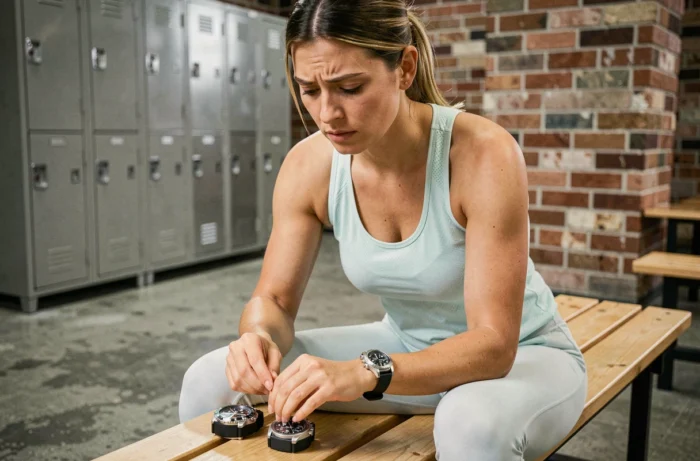
Programmable interval timer: the real tool for weightlifting and HIIT
Do you perform weightlifting sets with calibrated rest times, or HIIT circuits alternating effort and recovery? A classic stopwatch forces you to watch the screen, restart manually, and count mentally. This distraction breaks the rhythm and skews the regularity of breaks.
A programmable interval timer is a better replacement for a simple stopwatch for this type of session. You set the work duration, rest duration, and number of cycles in advance. The device manages the sequence on its own.
According to The Workout Mag (September 2026), recent solutions combine programmable work-recovery sequences with sound or vibration signals. The athlete stays focused on the exercise, not on a screen.
Audible, visual, or vibratory: adapting the signal to the environment
A beep is sufficient in a quiet garage. In a crowded gym with music, it becomes inaudible. Combining sound signals, vibrations, and a visible display from a distance covers most situations in group or individual training.
Some wall-mounted or floor-standing timers display readable numbers from several meters away, with a color code (green for effort, red for rest). This type of visual cue is particularly suitable for group classes or outdoor sessions.
Dedicated stopwatch or mobile app: decide based on your training
The free smartphone app covers basic needs. Why invest in a separate device? Two concrete reasons deserve consideration.
The first concerns interruptions. A notification, an incoming call, or an automatic screen lock interrupts the measurement. A dedicated stopwatch does one thing, and it does it without distraction. For structured training with sets, timed rest, and a volume of repetitions to adhere to, this reliability changes the quality of the session.
The second reason relates to durability. A sports stopwatch designed for the outdoors withstands rain, sweat, and shocks. A phone placed on the edge of a track or a weight bench remains fragile.
When the app is sufficient
For an occasional run, light progress tracking, or a simple end-of-set reminder, the mobile app does the job. If you don’t need multiple intermediate times or complex interval sequences, a dedicated device doesn’t provide significant added value.
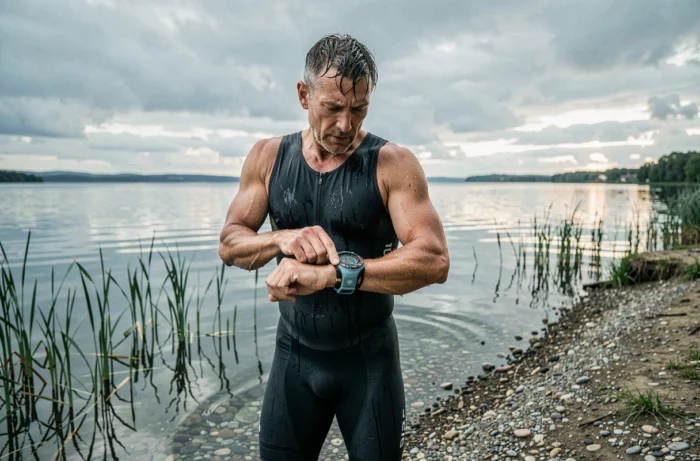
Memory and intermediate times: choose based on the volume of your session
Are you doing intervals on the track with about ten repetitions? Each interval generates an intermediate time (split) that the stopwatch must store without interrupting the overall countdown. The memory capacity determines the number of splits that can be recorded in one session.
An entry-level model often stores fewer than ten times. For weightlifting with short sets, this is sufficient. For long interval training (running, swimming, cycling), aim for a model capable of retaining several dozen readings.
Memory recall or data export
Some stopwatches allow you to view splits after the session. Others erase them upon reset. If you keep a progress journal or follow training cycles over several weeks, the memory recall function saves you from having to write down manually between each set.
Some recent models offer data transfer to a computer or phone. This function remains marginal on classic sports stopwatches, but it exists on some connected timers aimed at coaching.
The choice of a sports stopwatch relies less on the displayed accuracy than on the alignment between its functions and your actual practice. A long-distance runner, a HIIT coach, and a weightlifter do not have the same constraints regarding signal, memory, or ergonomics. Testing the button, checking readability in your usual conditions, and identifying whether you need a simple timer or an interval timer remains the most reliable method before any purchase.