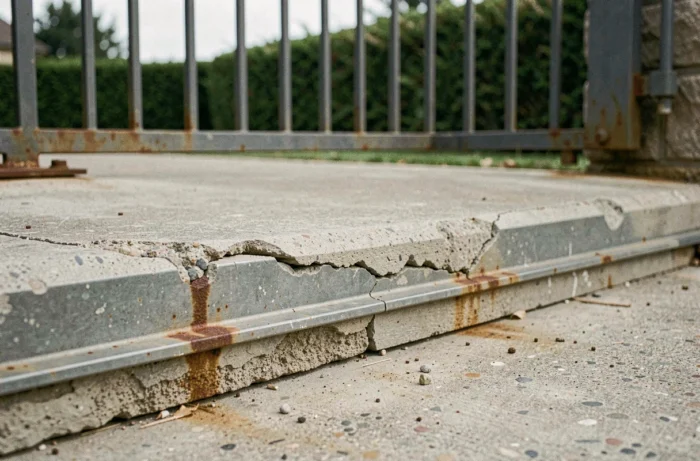
A threshold is the slab or concrete beam that connects the two pillars to the ground and on which the gate rests when closed. When this threshold cracks, sinks, or crumbles, the gate rubs, becomes misaligned, and allows runoff water to pass under the structure.
Repairing a damaged threshold is not just about filling a hole with mortar: the method depends on the type of degradation, the mechanical stress exerted by vehicles, and the management of water flow.
Slope and step: two technical constraints before any repair
Before touching the mortar, it is essential to understand why so many threshold repairs fail within a few months. The main cause is standing water. A flat threshold without slope retains moisture that seeps into micro-cracks, freezes in winter, and causes the concrete to burst again.
Manufacturers of outdoor thresholds recommend a slope of about 10% outward. On a gate threshold, this means that the highest point is on the courtyard side and that water drains naturally toward the street or gutter. During a repair, this slope must be recreated in the layer of added mortar or concrete.
The other often-overlooked parameter is the maximum step of 20 mm imposed by accessibility standards on outdoor thresholds. If the gate includes a pedestrian passage, a repair that creates a higher step becomes an obstacle for wheelchairs and strollers. Checking the height of the step with a level before and after the intervention prevents the need to redo everything.
Several solutions for repairing a gate threshold take these two parameters into account from the start, which radically changes the durability of the result.

Repair mortar or prefabricated threshold: choose according to the depth of the damage
The choice between filling with mortar and installing a prefabricated threshold depends on the thickness of material to be reconstructed and the condition of the existing reinforcement.
Repair with repair mortar
For thin layers (a few centimeters), a structural repair mortar applied on a chipped and dampened substrate yields good results. The substrate must be sound: if the concrete sounds hollow when tapped with a hammer, the degraded area is deeper than it appears and must be cleared until reaching compact material.
A bonding primer is necessary between the old concrete and the new mortar. Without this interface layer, the repair mortar will detach due to freeze-thaw cycles or repeated vehicle passage. The primer is applied with a wide brush, and the mortar is applied before the bonding layer dries completely.
Prefabricated threshold in reconstituted stone or concrete
When the sinking exceeds several centimeters or the threshold is fractured along its entire length, filling with mortar layer by layer becomes uncertain. Manufacturers now offer prefabricated pieces with integrated slope and drip edge, originally designed for entrance doors but increasingly used in the renovation of outdoor thresholds.
The advantage is twofold: the slope and waterproofing are calibrated in the factory, and installation is limited to sealing the piece on a bed of mortar adhesive after leveling the old threshold. The main disadvantage remains the standard size of these pieces, which does not always match the width between the pillars.
Preparing the substrate: the steps that determine long-term durability
Preparation accounts for the majority of the work time. A repair placed on a poorly prepared substrate will not last a season.
- Remove all friable material with a chisel and hammer, then use a pressure washer to eliminate fine particles. Sound concrete appears hard and compact under the chisel.
- Check the reinforcement: if any bars are exposed and show rust, brush them with metal and then apply a rust converter before covering. A corroded bar that swells under the new mortar will crack the repair from the inside.
- Moisten the substrate without soaking it. Dry concrete absorbs water from the fresh mortar and causes too rapid drying, weakening the bond. Saturated concrete prevents adhesion.
- Formwork if necessary: as soon as the thickness of the repair exceeds a few centimeters, lateral formwork with boards holds the mortar in place during setting and allows for shaping the slope.

Waterproofing the gate threshold: why filling alone is no longer sufficient
Recent technical guides emphasize a point that many tutorials ignore: a simple fill with mortar does not solve the waterproofing issue if the threshold contributes to protecting the building against rising water. A gate threshold located below a courtyard or garage can channel runoff toward the foundations.
After the repair, applying a surface water repellent or sealing resin on the renovated threshold blocks capillary water penetration. This layer is applied once the mortar is perfectly dry, usually after several days of drying depending on weather conditions.
For thresholds exposed to regular vehicle traffic, a finishing coating of epoxy or polyurethane resin adds mechanical resistance to abrasion that bare mortar does not have. This treatment significantly extends the lifespan of the repair.
Reinforcement and concrete resumption: strengthening a sunken gate threshold
A localized sinking often indicates a problem beneath the threshold: soil settling, insufficient foundation, or breakage of the original reinforcement. In this case, repairing the surface without addressing the cause produces a temporary result.
The resumption involves cutting out the sunken area with a diamond disc, clearing the degraded concrete down to the load-bearing soil, and then pouring new reinforced concrete with rebar tied to the old reinforcement using chemical anchoring rods. The mechanical connection between the old and new concrete is the critical point of any resumption.
Without this connection, the two masses of concrete work independently, and a shrinkage crack appears at the junction. Chemical anchoring (injection resin into holes drilled in the old concrete) creates a solid anchorage for the new rebar.
A well-repaired gate threshold combines rigorous preparation of the substrate, a choice of material suitable for the thickness of the repair, and active management of water flow. The temptation to apply a quick-setting layer of mortar on cracked concrete remains the primary cause of failure. Addressing the reinforcement, respecting the slope, and protecting the surface after drying transform a temporary repair into a durable intervention.